

Digital business and supply chain transformation
The increased digital transformation in business has disrupted the classical norms of doing business. To adapt themselves to the changing scenarios, the companies need to identify the current trends in digital transformation, deconstruct business models and discover new configurations (Remane et al, 2017). Gone are those days of ‘brick-and-mortars’ alone, businesses need to add an e-commerce component to their products and services.
With paradigm shift in focus towards customer-centric businesses, the companies face the challenge of meeting the rapidly changing customer demands. Supply chains need to evolve along with efficiency in procurement, manufacturing and distribution. Digitisation of supply chain offers scope for achieving targets and reduces spending (miebach, n.d.). Although debated, a successful roadmap in digitising supply chain involves the integration of cutting-edge technologies and revamped operations. Successful digitalisation also involves overcoming the challenges of aligning human resource and organisational structure with the technological advances (Genzorova, Corejova and Stalmasekova, 2019). Towards this end, we will consider the example of Accent Group and trace its successful digital transformation, especially in supply chain management.

A brief history of Accent Group Limited
Accent Group Limited is a footwear company established in 1981 with headquarter in Melbourne. Established as a retailer operating businesses through stores, the business giant through well-crafted strategies has evolved to become the leading regional retailer and distributor of performance and lifestyle footwear across Australia and New Zealand. Under its umbrella, Accent Group owns brands such as The Athlete’s Foot, Hype DC, Platypus Shoes, Skechers, Merrell, CAT, Vans, Dr. Martens, Saucony, Timberland, Sperry Top-Sider, Palladium, and Stance (Accent Group Limited, n.d.). The company operates over 420 stores with 10 different retail formats. Over the years, each brand of Accent had built unique customer relationships. With the industry shifting from product-centric to customer-centric, the digital transformation of Accent was inevitable. However, it was critical to retain the in-store customer experiences throughout their digital transformation journey and to reimagine them on the digital platform.
Supply Chain Transformation
Embracing e-commerce platform
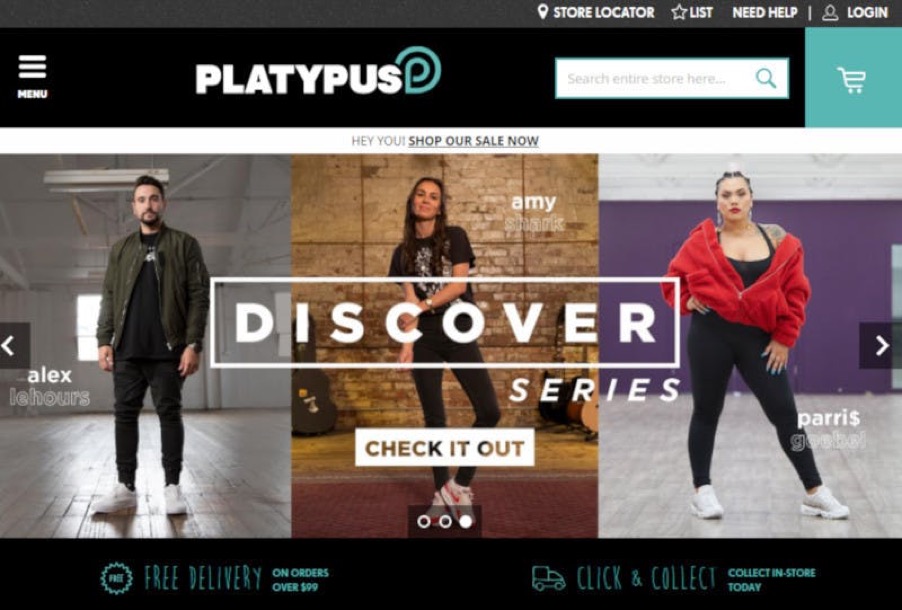
Accent chose to migrate its own brands’ websites to Magneto e-commerce platforms with flexible cloud solutions. Platypus, Australia’s top sneaker retailer brand was the first to be digitally transformed. The key requirements of the transformation were speed, flexibility in operation, and mobile-friendly customer experience. For the digital customer experience Accent partnered with eWave to bridge the gap between physical in-store and digital shopping experiences through engaging mobile applications (‘How Accent Group Grew Sales 10X in Just 10 Months’, n.d).
Expanding distribution network
According to Mark Teperson, Chief Digital Officer, Accent Group, the physical retail stores are not just important assets to the company but also represent excellent opportunities as distribution centres to deliver the products faster to the customers. As a part of its strive to build and expand its digital marketing and e-commerce capacities, Accent has turned 350 of its retail stores into distribution centres and heavily invested in logistics. The customers now could easily place an order from their online inventory anytime and get the product delivered in record time.
Offering new services and functionalities
As a step ahead, Accent in 2017, launched the ‘click and collect’ services which made the products selected by their customers available in real-time at local stores for collection. Through this digital platform, Accent was able to make the product reach 70-80% of the Australian population on the same day. This digital strategy created seamless customer experiences and in turn increased their brand loyalty.
As a part of their continuous supply chain transformation, the digital team in Accent enabled 13 websites for their business expansion through collaboration across different business units. In addition to ‘click and collect’, Accent introduced services such as ‘ship from store’, same-day delivery and endless aisle which delivers product unavailable at the stores, the next day without delivery charges (Bennett, 2018; Waldegrave, 2019).
Revolutionising customer services
Providing excellent online shoe fitting services to customers is a formidable challenge. Accent combined its in-store MyFit system with features of pressure mapping and motion analysis with MyFit app and pod clip-on devices to recreate the in-store fitting experiences of its customers. Accent also provides 24×7 customer services through live chats and emails (‘How Accent Group Grew Sales 10X in Just 10 Months’, n.d).
Impact of supply chain transformation
Their digital sales skyrocketed to 170% within six months of their digital transformation and managed to achieve 100% growth in FY17 (Bennett, 2018). Compared to FY17, Accent’s digital sales were up to 131% in FY18 due to increased functionalities and new services offered, as visible from the revenue generated. To manage the accelerated growth of sales in the digital platforms, Accent constructed a purpose-built digital hub in Melbourne (Waldegrave, 2019).

Conclusion
Interestingly, the digital transformation of Accent and its immediate impact on sales captured the attention of many. ‘How Accent Group Grew Sales 10X in Just 10 Months’ was the question that business experts started exploring (‘How Accent Group Grew Sales 10X in Just 10 Months’, n.d). The key strategy throughout the digitalisation has been to meet customers’ demands and to create a pleasant experience above all. Through partnering with e-commerce platforms and logistic businesses, Accent has adapted to the customer experience-driven commerce using the digital business strategy as the pillar of strength.

References
Accent Group Limited. (n.d.). Available at: http://www.accentgr.com.au/about-us/ (Accessed 3 March 2020).
Bennett, T. (2018). ‘CASE STUDY: Accent Group Turned Its Stores Into Distribution Centres To Drive Growth’, WHICH-50. Available at: https://which-50.com/case-study-accent-group-turned-its-stores-into-distribution-centres-to-drive-growth/ (Accessed 3 March 2020).
Genzorova, T., Corejova, T. and Stalmasekova, N. (2019). ‘How digital transformation can influence business model, Case study for transport industry’, Transportation Research Procedia, 40, p. 1053-1058.
‘How Accent Group Grew Sales 10X in Just 10 Months’. (n.d). Adobe. Magneto Commerce. Available at:https://magento.com/case-studies/digital-transformation-accent-group (Accessed 4 March 2020).
Hughes, C. (2019). ‘Total revenue of Accent group in Australia in the financial years 2014 to 2019’, Statista. Available at: https://www.statista.com/statistics/1076930/australia-total-revenue-accent-group/ (Accessed 4 March 2020).
Miebach. The supply chain engineers. (n.d.). ‘Transform into success’. Available at: https://www.miebach.com/en/services/supply-chain-transformation/ (Accessed 4 March 2020).
Rejeck, J. (2018). ‘The digital transformation of Accent Group: A retail case study (part 2)’, Xeim. Available at: https://econsultancy.com/the-digital-transformation-of-accent-group-a-retail-case-study-part-2/ (Accessed 4 March 2020).
Remane, G., Hanelt, A., Nickerson, R. C. and Kolbe, L. M. (2017). ‘Discovering digital business models in traditional industries’, Journal of Business Strategy, 38(2), p. 41-51.
Waldegrave, N. (2019). ‘The digital strategy behind Accent Group’s supply chain transformation’, Digital Supply Chain. Available at: https://www.supplychaindigital.com/company/digital-strategy-behind-accent-groups-supply-chain-transformation# (Accessed: 3 March 2020).
 HL
HL 
Thanks to the author for bringing such a wonderful blog and making full use of digital technology to realize digital transformation. Let me know about the innovations of accent in the business platform, distribution network, customer service, and supply chain. Accent has always implemented a customer-centric product concept and has demonstrated the success of Accent’s soaring sales in six months through several innovations, which is enough to prove its success. It also proves how great the transformation of digital business and supply chain has brought to a company. This blog is very inspiring, and I hope that the author can add some of Accent’s use of digital strategies to achieve supply chain transformation so that readers can further understand how Accent has become a successful digital retailer.
赞赞
Some investors like to pay close attention to management’s buying and selling of stocks as a good guide to whether a company’s stock has good value. Recently, Kogan.com Ltd (ASX: KGN) has been selling its stake in discount retailers in large numbers, and at this time the company may be the most enthusiastic. On the other hand, if the CEO is buying the stock of a business in the market, then usually this is a solid indicator that the person with the most detailed knowledge of operational performance believes that the stock has good value.
However, there are risks in the retail space; including the arrival of Amazon, debt-laden consumers, slow wage growth, and discounts to Accent Group’s more general competition. Given that the weak retail environment is hurting other brick-and-mortar retailers, some stores have been forced to close Marcs, David Lawrence, TopShop and Gap stores, and sales growth in the same store has been even more impressive. By investing heavily in the online space, Accent can still grow overseas or by opening new stores in Australia and New Zealand, with fiscal year 2018 sales growing 131% over the Internet.
赞赞
you are right, the digital model can improve company comprtitive, and it can bring disadvantages. For example, the high cost. My blog just focus on the improvrment of digital model, so there are not any negative effects.
赞赞