How Business Intelligence is Being Shaped by The Digital Economy
Self-evidently, the digital economy is not only changing the way people conduct their business but also has an impact on the information that is available from each business transaction.
- Historical Context
- The Digital Sales Funnel
- Automation
- Self-Service BI
- Future Developments
- Final Thoughts
- References
https://www.graymatter.co.in/wp-content/uploads/2017/09/CloudBI_Banner-min.jpg
Historical Context
Business Intelligence (BI) has always been used within organisations, even before it was termed as ‘business intelligence’. Historically, marketers always wanted to know how their efforts were being manifested. Therefore, they used tools such as sales graphs and expenses calculations to help in predicting their business. Since the analysis had to be done manually, the scope of such work was limited. It mainly involved drawing some trend lines and trying to make a guess about the direction of the company. With increased digitisation or automation, it is possible to capture a range of information about the process (Inmon, 2013).
The Digital Sales Funnel
As more sales are done electronically, the customer journey or sales funnel that is used to get the sale done can be captured. It is possible to say which marketing campaign has caused the customer to come to make the sale. It is also possible to track each customer at different stages of the sales process- whether they have viewed a product, placed it in their basket, and then not bought. As the amount of data that is available has increased, more sophisticated tools are needed to analyse the data and make informed decisions. This is where a BI analyst plays a crucial role. These people are tasked with the responsibility of recording the data and producing reports that could be viewed by the business leaders. A typical role for the business analyst is to speak with the organisation, find out what information is needed, and provide it as simplified reports.

Automation
As the amount of data to be processed has increased, the amount of work needed to prepare BI reports became unmanageable. This implies that automation is the order of the day. Automation is not only needed in report preparation, but also in data collection. This means that skills in SQL have increased, and new skills in SSIS are needed as well in order to develop ETL processes to take data from the input systems and process it for reporting. The development of data warehouses which incorporate data from a huge number of different systems and sources enable analysis to be done across whole businesses. This includes taking data from sales, finance, CRM, and other systems in order to give a more complete picture of what is happening with the business. With the increased use of cloud computing (Gurjar & Rathore, 2013), spreadsheets have taken a backseat to data visualisations and interactive dashboards that help in processing complex data into simple and useful information that assist in strategic business decision.
Self-Service BI
The most recent developments in the industry have been the trend towards self-service Business Intelligence (Alpar & Schulz, 2013)or self-service analytics. This means that BI developers prepare sets of data with certain pre-calculated analysis. It can be directly passed onto business owners who might have limited skills in analysis. By using tools such as PowerBI or Tablea, business owners can directly get the answers that they want regarding their business from the data collected. This means that the time to process information is reduced as they don’t need to wait for a BI developer to prepare the report they want. They can now do it themselves without even knowing how to code! However, this has also driven business organisations towards adopting a data-driven culture.

Future Developments
BI is continuing to develop. Big Data is coming, and this is where organisations capture data on everything and create huge stores of information that can be analysed and processed to give a more complete image of a business. BI tools are also adapting to deal with new requirements. This means that soon, business leaders will be able to ask natural language questions of their data and get the answers they are looking for. ‘Which are my 5 worst-performing stores?’ would be able to be handled and the data given back almost immediately. This will let the business leader do what they need to do without having to learn new skills. However, it is important to choose the right tool to fit an organisation’s distinctive and precise needs (Bose, 2009) and the BI analyst with play an important role. In the future, BI reports will also be able to give the story behind certain data. This storytelling can reveal a lot about how the data came about. For example, if one of your worst-performing stores was because it had suffered a fire that put it out of action for 6 months then that is important to know

Final Thoughts
BI is an evolving profession and workers need to adapt their skills to rule the digital economy era.

References
Gurjar, Y. S., & Rathore, V. S. (2013). Cloud Business Intelligence – Is What Business Need Today. International Journal of Recent Technology and Engineering, 1(6), 81-86.
Alpar, P., & Schulz, M. (2016). Self-Service Business Intelligence. Bus Inf Syst Eng., 58(2), 151–155.
Inmon, W.H. (2013). Evolution of Business Intelligence. In P. Rausch, A. Sheta & A. Ayesh (Eds.), Business Intelligence and Performance Management. Springer, London. https://doi.org/10.1007/978-1-4471-4866-1_17
Bose, R. (2009). Advanced analytics: opportunities and challenges. Industrial Management & Data Systems, 109(2), 155-172.
 HL
HL 



Before I read your blog post, I didn’t know much about Business Intelligence. I’m glad you shared this information to me.
We often see vocabulary such as big data, data visualization, data analysis, data warehouse, but their specific concepts are always very vague. Through your blog, I learned that before business digitization, it can be done through simple sales graphs and expenses calculations but as the amount of data increases, business intelligence automation can connect every business data system and automatically introduce data into the database.
I am curious, the main difference between Business Intelligence and previous data analysis?
In the process of building business intelligence, how to solve the following challenges:
For example, data analysis involves too many tools and technologies, is costly, and it is difficult to meet the insight needs of the business. The lack of refined professional service capabilities leads to inefficient problem solving and negative user feedback.
赞赞
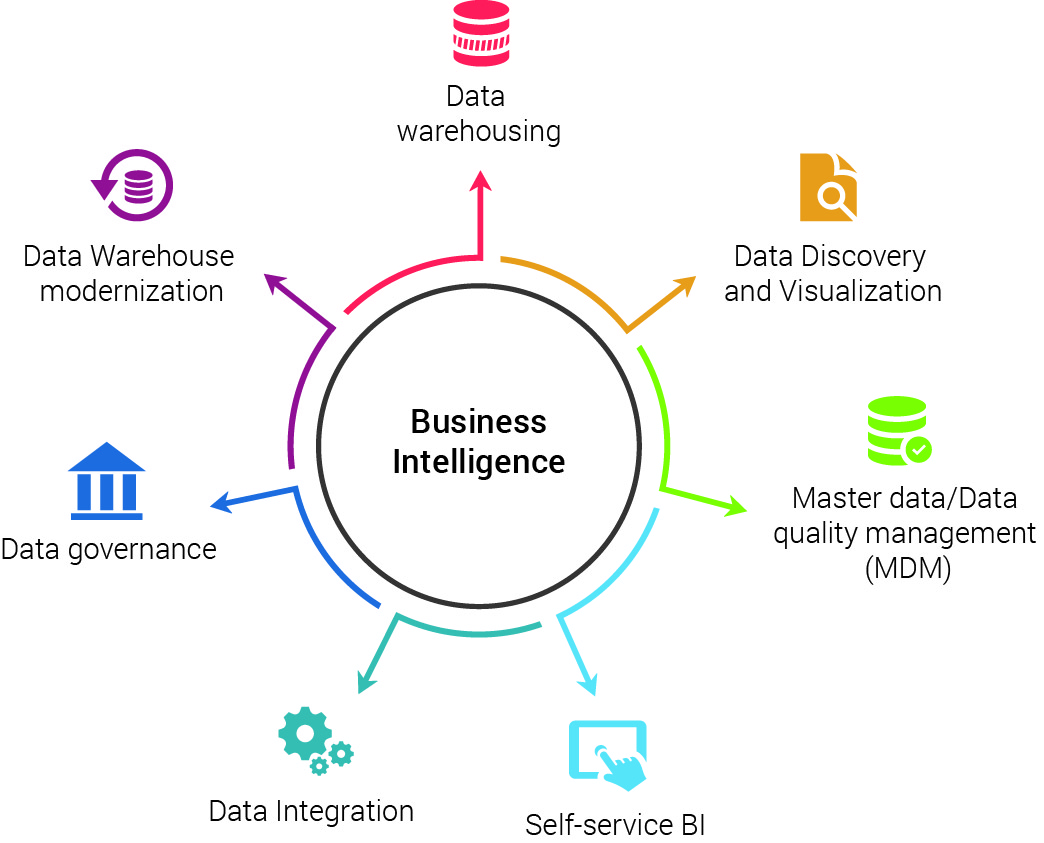
Blogger analyzed the changes and future development of business intelligence in recent years, from data generation to data collection to data popularization. It reflects the three different stages of business intelligence and is very representative. But one thing blogger didn’t mention is that while data is being collected automatically, analysts’ understanding of business intelligence has also become deeper. The appearance of business intelligence is visual analysis, and the essence of business intelligence is still business and management issues. The data comes from the business, use the data to discover business problems, and then return to the business to improve business performance. This is reflected in the blogger’s last BI contact diagram. Business analysis models are difficult to come up with by business intelligence professionals. This requires cooperation with customers. The knowledge of both parties can magnify the role of business intelligence.
赞Liked by 1 person